
Governments are increasingly creating specific rules for how digital services must operate. Platforms are being asked to demonstrate compliance, regulators are being given greater oversight, and enforcement systems are becoming an increasingly important part of the regulatory process.
As explored throughout the previous blogs in this series, digital regulation starts with establishing the rules, followed by demonstrating compliance and providing the evidence needed to assess whether those requirements are being met. But once a regulatory decision has been made, what happens next?
What happens when that decision needs to become a practical digital outcome?
This is where the conversation moves beyond any single regulation or policy area. Whether the issue is child safety, illegal online gambling, scams or another regulated digital service, governments may increasingly need a way to translate regulatory decisions into enforceable policies across the digital infrastructure that connects users to online services.
From Regulation to Enforcement
Throughout this series, we have followed the progression from regulation to enforcement.
Governments establish requirements. Platforms implement controls and provide evidence that they are meeting those requirements. Independent assessments and regulatory oversight can determine whether those requirements are being met. But enforcement represents another stage in that process.
A regulator may determine that a service is not complying with a requirement, but acting on that decision can be more complicated when the service operates across borders. Technical infrastructure can help translate regulatory decisions into practical measures, including restricting access to services that fail to meet national requirements.
That distinction is important because digital regulation does not operate in isolation from the infrastructure of the global internet.
The Challenge of Enforcing Digital Rules
Digital services can operate across multiple jurisdictions, change domains, modify infrastructure and introduce new services quickly. A regulatory decision may identify what needs to happen but putting that decision into practice can require mechanisms capable of operating at the scale and speed of the internet.
This creates a potential gap between regulatory authority and technical enforcement.
The regulatory process may establish that a particular service, category of service or online activity should be subject to restrictions within a jurisdiction. The remaining question is how an authorised policy can be applied consistently across the networks through which users access those services.
Child safety may be one of the most visible areas of emerging digital regulation, but the same broader infrastructure question can arise around:
- Illegal online gambling
- Scams and fraudulent services
- Prohibited or unauthorised online services
- Other digital services subject to country-specific regulation
The specific rules and legal authorities will differ by issue and jurisdiction. The underlying infrastructure challenge can be similar: how does an authorised regulatory decision become an enforceable digital policy?
Does the Internet Need an Enforcement Layer?
Not every regulatory decision requires network-level blocking, and technical infrastructure should not replace regulation, compliance processes or regulatory authorities. However, as governments introduce more detailed digital requirements, they may need a way to put regulatory decisions into effect across the networks within their jurisdiction.
This raises the question of how regulatory decisions can be carried through to the digital services people can access. Governments and regulators determine what must be enforced, while compliance processes assess whether requirements are being met. Network infrastructure can play a separate role in implementing enforcement policies.
An enforcement layer gives governments a way to act on regulatory decisions at the network level, restricting access to services that do not meet national requirements, even when those services operate beyond the country’s borders. Rather than relying solely on action from the service provider, this approach provides a technical means of applying enforcement within the country’s own digital infrastructure.
Why Real-Time Enforcement Matters
The internet is not static. The internet is not local.
Domains change. Services move. New websites appear. Existing services can re-emerge under different infrastructure. Static lists and manually maintained policies are stale before they are even put in place. Technical infrastructure for regulatory enforcement needs to account for those changes in real time.
This is why classification and dynamic policy enforcement are important. Rather than relying solely on individual URLs or fixed blocklists, network-level infrastructure can use category intelligence and centrally managed policies to respond as online services and domains change.
The goal is not simply to block a particular address. It is to apply a defined policy consistently as the digital environment changes.
From Blocking a URL to Enforcing a Policy
There is an important distinction between traditional URL blocking and policy-based enforcement.
A URL blocklist identifies individual destinations. A policy-based approach can apply a broader classification or regulatory policy to the types of services that fall within its scope. For governments considering country-level enforcement, this distinction can become significant.
If an authorized policy applies to a category of regulated service, the technical infrastructure used to enforce it needs to operate beyond a collection of manually identified URLs. It needs to be capable of applying the policy across participating network environments and responding as the digital landscape changes.
This is where network infrastructure can become part of the broader regulatory conversation.
Where Netsweeper Fits
Netsweeper’s nsEnforce is designed to help governments translate regulatory decisions into network-level enforcement. It does not define regulation, determine whether a company is compliant, or replace the authority of a regulator. Instead, it provides the technical infrastructure for applying an authorised, government-defined policy at the network level.
This places nsEnforce at the final stage of the regulatory process:
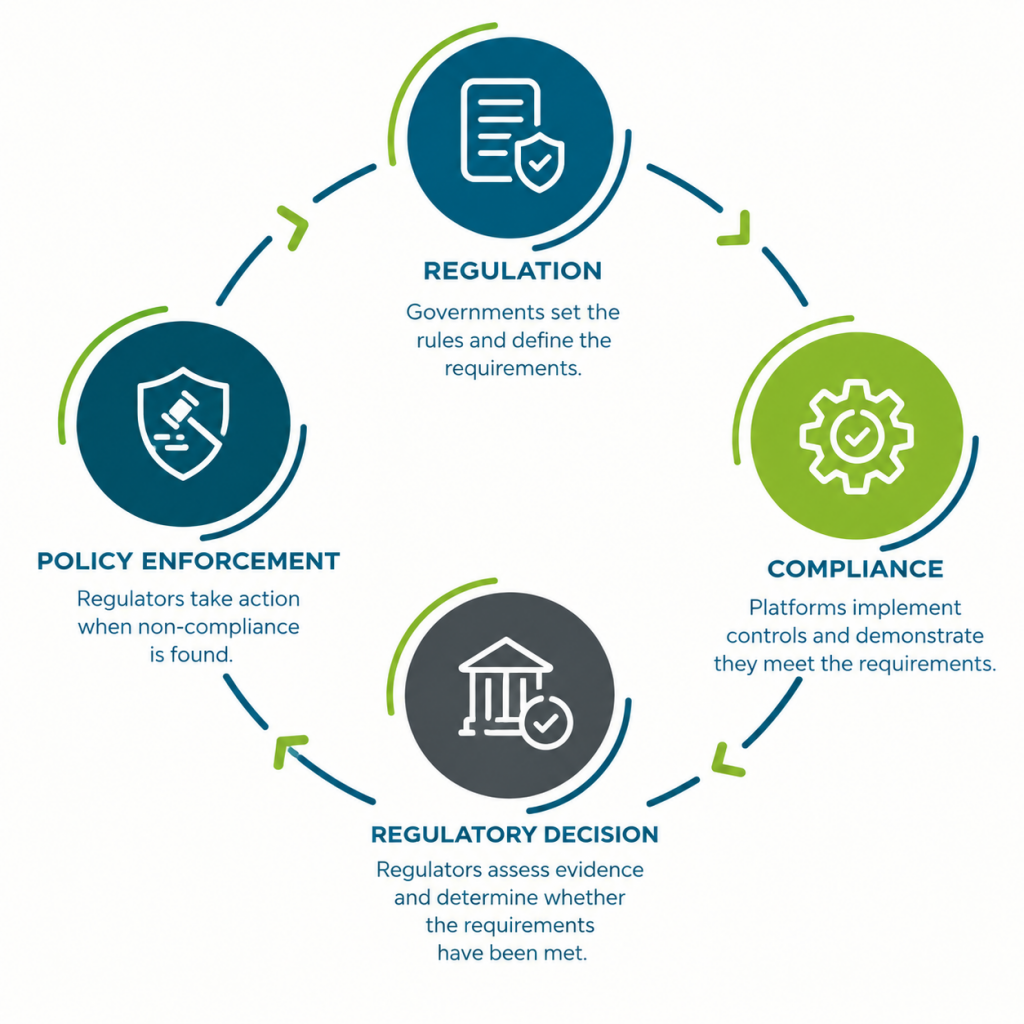
In this context, nsEnforce provides a mechanism for translating an authorized regulatory decision into a network-level enforcement action. For country-level applications, it can support centrally managed enforcement policies across participating network environments, helping governments put authorized decisions into practice at scale.
Beyond One Regulation
The potential application of this model extends beyond the issue that brought the conversation into focus.
Child online safety is one example of an area where governments are establishing new digital requirements. Other areas, including illegal online gambling, scams and other regulated services, raise similar questions about how regulatory decisions can be put into practice.
In these cases, enforcement may require more than blocking an entire category of content or services. For example, some gambling websites may be legally permitted while others operate illegally. A managed enforcement solution needs to distinguish between the two, applying restrictions in line with local laws and regulatory requirements while allowing permitted services to remain accessible.
The approach will depend on the applicable laws, regulatory authority and enforcement framework in each jurisdiction. As digital regulation expands, governments will need practical ways to apply their decisions with the precision required to restrict prohibited services without unnecessarily limiting access to lawful ones.
Building the Full Regulatory Path
The future of digital regulation may therefore involve a much more complete path:
Regulation → Compliance → Evidence → Assessment → Regulatory Decision → Enforcement
Each stage has a distinct role.
Regulation establishes what is required. Compliance provides evidence that requirements are being met. Assessment and regulatory oversight determine whether those requirements have been satisfied. Enforcement provides the means to act when an authorized decision requires action.
That final step is where digital infrastructure enters the conversation.
Closing the Enforcement Gap
The evolution of digital regulation is not simply about creating more rules. It is about creating a workable path between those rules and their practical application.
As governments take a more active role in regulating digital services, the question of enforcement will increasingly extend beyond legal authority alone. It will also involve the infrastructure required to apply authorized policies across the networks that connect people to the internet.
The future of digital regulation may depend not only on defining the rules, but on building a complete path from regulation to compliance to enforcement.
For Netsweeper, that is where the conversation around country-level enforcement begins.
This is Part 4 of our series exploring the evolving relationship between digital regulation, compliance and enforcement. Want to learn more about country-level digital enforcement? Book a demo to explore how Netsweeper’s nsEnforce provides a mechanism for translating authorized government policies into network-level enforcement.