
When governments discuss tackling illegal online gambling, much of the focus is on regulation, technology and identifying unlawful operators. But an equally important question is how enforcement should be funded.
Licensed operators have a commercial interest in tackling illegal gambling, as they must compete with businesses that operate outside the regulatory framework. Recognizing the impact of this competition, licensed operators have expressed a willingness to contribute towards stronger enforcement.
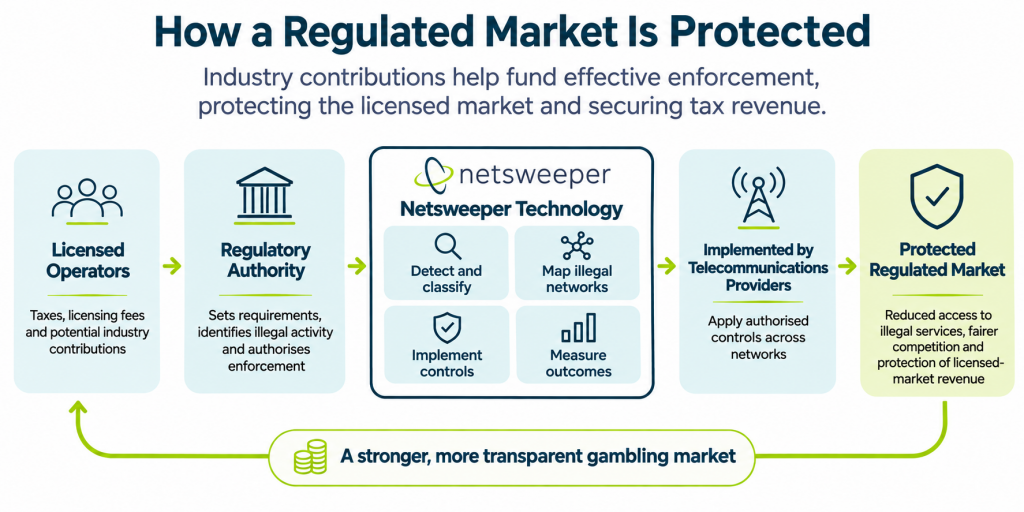
This raises an opportunity for governments to consider how industry contributions, existing regulatory fees and public funding could support enforcement efforts. Any approach must be sustainable, transparent and deliver measurable results, while ensuring that regulatory decisions remain firmly in the hands of the authorities.
A Real-World Example: Australia’s Cost-Recovery Levy
There is already precedent for recovering regulatory costs from the industries being regulated. Australia’s Interactive Gambling (Cost Recovery Levy) Act 2026, for example, introduced a levy on licensed interactive wagering providers to recover specified government costs associated with wagering regulation and consumer protection.
The Australian levy is not a general fund for blocking illegal gambling websites. However, it illustrates how governments can recover defined regulatory costs from licensed businesses rather than relying entirely on general public funding. Similar principles could inform discussions about how illegal gambling enforcement is resourced.
Protecting the Revenue Generated by Licensed Operators
The financial case for tackling illegal gambling extends beyond the cost of enforcement itself. When customers gamble with licensed operators, that activity takes place within the local regulatory framework. Operators are subject to licensing conditions and applicable taxes, contributing to government revenue. Illegal operators can attract customers without necessarily meeting the same obligations or making the same contributions.
The more gambling activity that takes place outside the regulated market, the greater the potential loss of tax revenue and the more difficult it becomes for licensed businesses to compete on equal terms.
Restricting illegal gambling can help direct customers towards licensed services. While blocking an illegal website will not guarantee that every customer moves to a legal operator, it can reduce the availability of unlawful services and give regulated businesses a fairer opportunity to compete.
For governments, protecting the licensed market is therefore both a regulatory and an economic consideration. It helps uphold the licensing system while supporting the businesses that contribute to public revenue.
Should Licensed Operators Help Fund Enforcement?
Licensed operators have a clear commercial interest in preventing illegal competitors from reaching customers in their markets. They invest in meeting regulatory requirements yet must compete with businesses that may avoid those same costs. Their motivation is straightforward: more effective enforcement can help protect their market share, reduce unfair competition and support the value of holding a local licence.
There are different ways governments could involve the industry in funding enforcement. Existing taxes and licensing fees already provide revenue, while additional arrangements could include initial operator contributions, recurring protection or licensing fees, dedicated regulatory levies or direct contributions towards agreed initiatives.
Funding could also support more than the cost of blocking websites. Depending on the regulatory model, it could help cover the initial technology deployment, ongoing enforcement, licensing administration, monitoring and revenue assurance.
Any arrangement would need to be transparent, with clear accountability for how contributions are collected and spent. Most importantly, funding from operators must not influence regulatory decisions. Authorities must retain control over identifying unlawful activity, setting enforcement priorities and determining what action is appropriate.
From Regulatory Decisions to Action
Funding is only part of the equation. Regulators also need a reliable way to act when illegal gambling services are identified.
A website may be investigated and confirmed as operating unlawfully, but that decision alone does not prevent customers from accessing it. Authorities need processes that allow them to assess unlawful activity, determine the appropriate response and ensure restrictions can be implemented.
Denmark offers a useful example. In its 2025 reporting, the Danish Gambling Authority stated that it had obtained court orders to block 334 websites offering illegal gambling during the year. It also reported an agreement with the Danish telecommunications industry to help address mirror sites. Under the arrangement, certain mirror sites can be blocked without a separate court order when a court has already ruled that the original content was illegal.
This is important because illegal gambling websites can reappear under different addresses after restrictions are imposed. A process that accounts for mirror sites can help authorities respond more efficiently, rather than treating every new address as an entirely separate case.
It also highlights the role of telecommunications providers. Regulators establish what action is authorized, while providers implement the restrictions across the networks they operate. Technology needs to support both the identification of illegal activity and the consistent application of those decisions.
How Netsweeper Supports Regulatory Enforcement
Effective enforcement requires more than blocking individual websites. Regulators need visibility into the wider illegal gambling landscape, the ability to act on that information and a way to measure the results.
Netsweeper brings these capabilities together through a countrywide platform for real-time detection, classification and enforcement of online gambling activity across telecommunications networks.
Our technology supports regulators and telecommunications providers through five key capabilities:
- Real-Time Classification: Identifies and categorizes gambling-related domains, including licensed and unlicensed operators, affiliates and advertising. This provides visibility into activity across networks and helps distinguish legitimate services from those operating outside the regulatory framework.
- Authorised Network Enforcement: Enables telecommunications providers to implement restrictions at the network edge, including blocking or allowing access to identified content and displaying warnings to users, depending on applicable policies.
- Centralised Policy Management: Supports consistent enforcement across large subscriber networks, with continuous monitoring to identify new domains and changes in the illegal gambling landscape.
- Reporting, Analytics and Audit Trails: Provides evidence-grade audit logs to support compliance reviews, tax audits and investigations. Reporting can also track illegal domain reach, blocked sessions and traffic shifts towards licensed operators, helping authorities assess enforcement activity and its impact.
- Network Intelligence: Goes beyond individual websites to help map the wider networks behind illegal gambling, including offshore and mirrored domains, affiliate networks and advertising channels. This intelligence helps regulators identify connected activity and prioritize enforcement efforts.
Designed for large-scale telecommunications deployments, Netsweeper supports countrywide filtering without introducing latency into the customer browsing experience. We provide the infrastructure that enables telecommunications providers to implement authorised restrictions, while regulators retain control over enforcement requirements.
Making Enforcement a Sustainable Investment
The question of who pays for enforcement should be part of the wider discussion about protecting regulated gambling markets.
Licensed operators already contribute through taxes, licensing fees and other charges. When illegal gambling is restricted, more customers have the opportunity to use licensed services, supporting legitimate businesses and the public revenue they generate. Some operators are also prepared to contribute directly towards enforcement because they recognize the commercial value of a fairer market.
For regulators, the opportunity is to consider how industry contributions and public funding can support the full enforcement process, from initial implementation and ongoing monitoring to revenue assurance and the administration of a protected market.
But funding must be matched by the ability to act. Authorities need visibility into illegal gambling activity, the means to implement authorised restrictions and reliable reporting to understand whether enforcement is working.
By bringing these elements together, governments can strengthen the protection of their regulated gambling markets, support licensed operators and address the financial impact of illegal online gambling.