
Online Scams Became Too Big for Traditional Enforcement
For years, Australia faced a challenge many governments are now confronting: scam websites were multiplying faster than authorities could remove them.
Fraudsters were launching fake investment platforms, phishing pages, fake retail websites, and cryptocurrency scams designed to steal personal information and financial assets from Australians. By the time victims reported the scams and investigators responded, many fraudulent websites had already disappeared and resurfaced elsewhere under new domains.
Traditional enforcement methods simply could not keep pace.
Manual takedowns required investigators to identify scam websites, gather evidence, contact registrars or hosting providers, and wait for action. That process often took days or weeks, while scam websites have a short lifespan.
This forced Australian regulators to rethink their approach.
Australia Shifted Toward Faster Scam Disruption
In 2022, Australia’s Australian Securities and Investments Commission (ASIC) and the Australian Competition and Consumer Commission (ACCC) launched a pilot focused on rapidly identifying and removing scam websites.
The results highlighted just how large the problem had become.
During a three-week trial, regulators helped block 5,579 scam websites, including:
- Fake investment platforms
- Cryptocurrency scams
- Phishing websites
- Fake online retail stores
- Malware-related scams
- Technical support fraud websites
Many of these websites were designed to impersonate legitimate financial institutions and businesses to trick users into handing over credentials or transferring funds.
The Problem Didn’t Stop There
The pilot proved online scam infrastructure was operating at massive scale. Australia continued expanding enforcement efforts. By early 2024, ASIC announced it had disrupted nearly 3,500 scam websites through its new takedown capabilities.
Later that year, the number grew to more than 7,300 scam and phishing websites removed, including:
- 5,530 fake investment platforms
- 1,065 phishing scam websites
- 615 cryptocurrency scam websites
By 2025, ASIC reported it was shutting down approximately 130 scam websites every week, with more than 10,000 scam sites and malicious advertisements removed.
Why This Matters Globally
Australia’s approach highlights a major reality many governments are now facing. Scam prevention can no longer rely solely on consumer awareness campaigns or manual enforcement.
Scammers operate like businesses:
- They automate website creation
- Rotate domains quickly
- Move between hosting providers
- Launch campaigns globally
- Rebuild infrastructure almost immediately after takedowns
Governments need equally fast response capabilities.
How Netsweeper Helps Governments Respond Faster
Australia’s efforts demonstrate an important shift happening globally: governments can no longer rely solely on manual takedowns, consumer reporting, or reactive fraud investigations.
Scam infrastructure moves too quickly.
Fraudulent websites can be launched, rotated, and replaced within hours, often faster than regulators can coordinate traditional enforcement responses. While Australia has built internal processes to rapidly disrupt these threats, many countries and telecom providers still lack the infrastructure needed to respond at this speed.
This is where Netsweeper helps.
Netsweeper enables governments, regulators, and telecom providers to identify and block malicious websites in real time at the network level before users can access them. As shown below, Netsweeper can detect and block scam websites at the point of access, helping organizations stop threats before users ever reach malicious content.
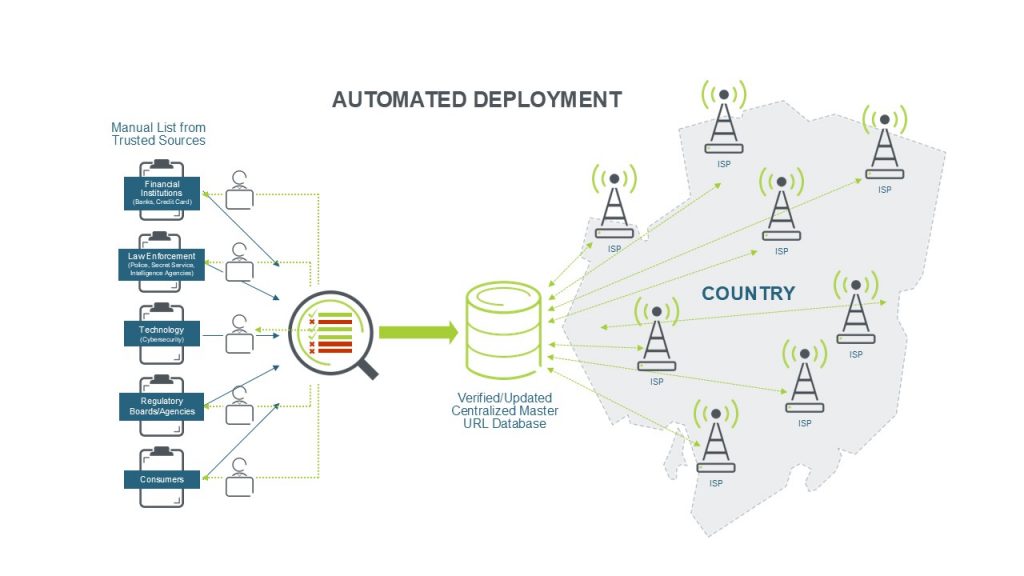
This supports efforts similar to what Australia is accomplishing by helping organizations:
- Block scam and phishing domains instantly
- Prevent user access to malicious websites
- Reduce fraud exposure across national networks
- Strengthen digital sovereignty efforts
- Scale enforcement without relying on manual intervention
Reactive enforcement alone is no longer enough. Real-time prevention at the infrastructure level is becoming essential to stopping modern scam operations.
The Bigger Lesson for Governments and Telecom Providers
Australia’s response shows that infrastructure-level intervention is becoming essential. Rather than waiting for citizens to report scams after losses occur, governments and network providers can block access to malicious domains before users ever engage with them.
This approach helps:
- Reduce fraud losses
- Protect citizens
- Limit exposure to phishing attacks
- Disrupt criminal revenue streams
- Reduce strain on law enforcement teams
What Comes Next
Australia has shown that scam disruption at scale is possible, but the battle remains ongoing because scammers continuously rebuild. The next evolution requires real-time enforcement that can detect and block malicious infrastructure the moment it appears.
Learn how governments and telecom providers can stop scam websites before they reach users.